
EF-4 Tornado Hits Enid
An EF-4 tornado with estimated winds of 170 to 175 mph tore through Enid, Oklahoma, damaging at least 40 homes and causing heavy destruction in both residential and commercial areas, while leaving no fatalities and only minor injuries in its path. The outcome in Enid, Garfield County, stands out not because the tornado was weak, but because residents and businesses had enough warning and took shelter before the worst of the storm arrived.
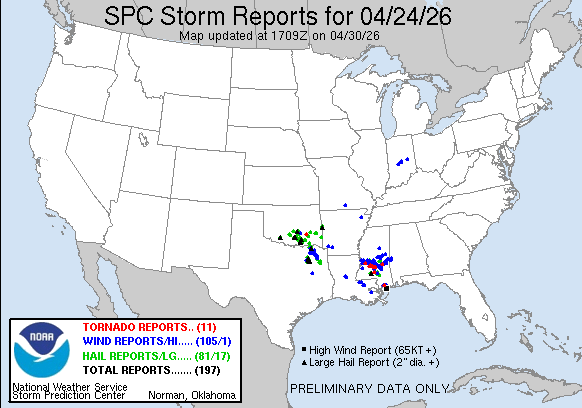
Source: NOAA Storm Prediction Center
The event is a reminder that even in communities accustomed to severe weather, a violent tornado can overwhelm buildings, disrupt operations, and leave a wide damage footprint in a matter of minutes. In Oklahoma, where spring and early summer often bring repeated rounds of thunderstorms, the combination of unstable air, strong wind shear, and favorable storm-scale dynamics can quickly turn a routine forecast into a high-risk day. For facility managers in Enid and across north-central Oklahoma, the lesson is direct: structural damage can be severe even when casualties are limited by preparation.
Violent tornado damage in Garfield County
Enid sits in a part of Oklahoma that regularly faces tornado threats during peak season, and the latest storm adds to a long record of destructive severe weather across the state. An EF-4 rating places the tornado in the violent category on the Enhanced Fujita scale, indicating the kind of wind speeds capable of leveling well-built structures, stripping roofs, and damaging large commercial buildings. In practical terms, that means warehouses, schools, municipal facilities, and industrial sites in Enid and surrounding Garfield County must plan for more than roof loss or broken windows. They must plan for structural failure, debris impact, and prolonged outage conditions.
Damage reports from the storm showed that the tornado affected both neighborhoods and business areas, a pattern that complicates recovery because it interrupts housing, commerce, and local services at the same time. Even when injuries are minor, the operational impact can be broad. Businesses may face inventory loss, utility interruptions, and temporary closure. Schools and public facilities may need to shift schedules, inspect buildings, and account for staff and students. In a city like Enid, where local employers and public agencies often share the same weather exposure, the recovery burden extends beyond the homes that were damaged.
Severe tornadoes in Oklahoma are closely watched by the Storm Prediction Center and local offices of the National Weather Service, which issue watches and warnings based on evolving storm conditions. Those alerts are only effective if people have a place to go and a process to get there quickly. In this case, the lack of fatalities suggests that warning dissemination, public response, and sheltering all worked together as intended, even though the tornado still caused major physical damage in Enid.
Why the outcome was different
The difference between a destructive tornado and a mass-casualty event often comes down to timing, access, and compliance. If a warning reaches people early enough, and if they know exactly where to go, survival odds improve sharply. That is especially true in commercial settings where employees may be spread across large footprints, and in schools or municipal buildings where evacuation routes must be simple and fast. In Enid, the reported minor injuries and absence of fatalities point to a community that did not wait for visual confirmation of danger before moving to shelter.
That response matters because EF-4 tornadoes can produce debris fields that make last-second movement unsafe. Once a violent tornado is on the ground, exterior travel becomes a risk in itself. For operations directors and school administrators in Enid, Oklahoma, the practical takeaway is that shelter access must be built into the facility plan, not improvised during a warning. A building may meet code and still leave occupants vulnerable if it lacks a hardened refuge or if the nearest safe area is too far from workspaces, classrooms, or production floors.
For businesses reviewing their severe weather posture after this event, the question is not whether a tornado can hit Enid again. It is how much time a facility has to move people into protection when the next warning is issued. That is why many organizations evaluate commercial tornado shelters as part of broader continuity planning. A shelter is not a substitute for forecasting or warning systems, but it gives those systems a place to lead people when the risk becomes immediate.
Preparedness lessons for Enid businesses and schools
Enid’s experience also underscores a point familiar to municipal planners across Oklahoma and the broader Plains: severe weather planning has to account for both the direct hit and the secondary disruption. A tornado that damages homes can also affect road access, power distribution, communications, and emergency response routes. Schools may need to shelter students longer than expected. Industrial facilities may have to pause operations while crews inspect for roof damage, broken lines, or compromised equipment. Municipal buildings may become temporary coordination points for residents who need information and assistance.
Facility leaders can use our Storm Planner to evaluate shelter placement before the next severe weather outbreak. That is especially relevant in Enid and other Oklahoma communities where a warning may arrive with limited lead time and where multiple buildings on one campus or site may require different protection strategies. The tool helps organizations think through occupancy, access, and placement in a way that aligns with real-world operations rather than ideal conditions.
For schools, the planning challenge is often movement speed and supervision. For industrial sites, it is shift coverage and the distance between work zones and safe areas. For municipalities, it is public access and redundancy. In each case, a tornado shelter can reduce dependence on ad hoc decisions during a warning. That is one reason companies and public agencies across Oklahoma review their shelter plans after major events like the Enid tornado, rather than waiting for the next storm season to expose the same gaps.
The broader weather pattern that produces violent tornadoes in Oklahoma often includes strong spring storm systems, a volatile air mass, and a favorable wind profile that supports rotating thunderstorms. When those ingredients align, the risk can escalate quickly across multiple counties. Enid, Garfield County, and nearby communities should expect future severe weather episodes to be monitored closely by forecasters, with watches and warnings issued as conditions warrant. Prepared facilities are better positioned to absorb the impact when that happens.
Commercial facilities and shelter planning
Commercial Facilities, Speak with a Specialist if your Enid, Oklahoma, property, school, or municipal site still relies on standard interior rooms or hallways for tornado protection. You can view available shelter inventory and explore rental options for projects that need a faster path to protection. Use the Storm Planner to map shelter needs, then contact our team to discuss next steps. If you want to review past installations and configurations, our photo gallery shows how commercial tornado shelter solutions are deployed across different facility types.
For organizations operating in Enid, across Garfield County, and throughout Oklahoma, the recent EF-4 tornado is a clear reminder that severe weather planning has to match the hazard. A tornado shelter is one of the few measures that directly protects people when a violent storm reaches the site. For businesses, schools, municipalities, and industrial facilities, that protection can make the difference between a damaged building and a far worse outcome.