
Tornado Warning Hits Southeast Virginia
A tornado shelter is a live operational issue for facilities in Surry, Prince George, and Charles City counties after a tornado-warned storm crossed southeastern Virginia on Sept. 12 and prompted concern near Spring Grove. The National Weather Service later confirmed EF-0 tornado damage near Spring Grove, while local reporting said there were no tornadic reports in Prince George or Charles City counties.
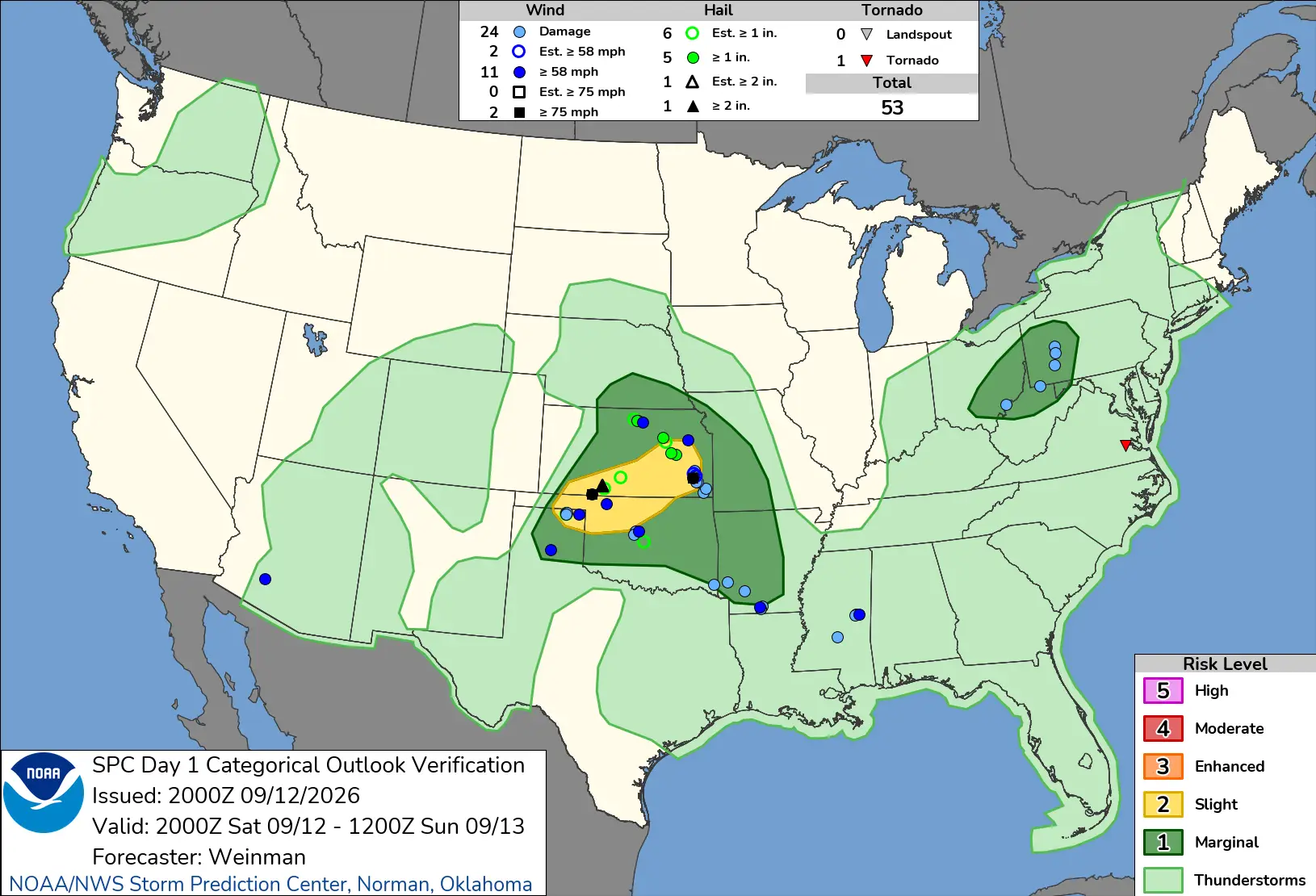
Source: NOAA Storm Prediction Center
Spring Grove Damage Confirmed by NWS
The confirmed damage near Spring Grove puts this event in the lowest EF category, but it still matters for facility operations. EF-0 tornadoes can damage roofs, siding, trees, and light structures. They can also disrupt power and access roads. For a plant manager, that can mean halted shifts, delayed deliveries, and a fast review of where employees would go during the next warning.
This storm moved northwest across parts of southeastern Virginia. That track is consistent with a fast-moving convective line or embedded rotation in a broader severe weather setup. In early fall, Virginia can still support strong thunderstorms when warm, moist air remains in place and upper-level support arrives. The Storm Prediction Center often highlights this kind of setup when wind shear and instability overlap.
The warning area covered Surry, Prince George, and Charles City counties. That matters because warnings are issued for a polygon, not a single point. A warning can include locations that never see a tornado. It can also miss the exact spot where damage occurs if the circulation is brief or narrow. That is one reason a tornado shelter plan must be tied to the warning process, not just to past damage.
What This Means for Virginia Facilities
Spring Grove sits in a part of Virginia where severe weather can move quickly and leave little time for response. Rural and semi-rural sites often have longer travel distances between buildings, parking areas, and protected spaces. That creates exposure during a warning. It also makes accountability harder when a storm arrives during a shift change or delivery window.
For industrial sites in Surry County, Prince George County, and Charles City County, the operational risk is not limited to direct structural damage. A warning can trigger lockouts, production pauses, and temporary evacuation of exposed work areas. Even when the tornado threat proves brief, the interruption can affect output, staffing, and safety checks for the rest of the day.
Virginia sees tornadoes in every season, but late summer and early fall remain active periods. Storms can form along boundaries left by previous convection or along frontal systems moving through the Mid-Atlantic. The National Weather Service uses warnings, radar, and local surveys to sort out what happened after the fact. For operations teams, the key issue is not the survey result alone. It is whether the site had a protected place to send people during the warning.
Tornado Shelter Planning After a Warning
This event is a reminder that a tornado shelter plan should match the layout of the property. A large facility in Spring Grove may have open yards, loading docks, or detached buildings that increase exposure. A commercial tornado shelter can reduce the distance between a warning and a protected space. It also gives managers a fixed location for drills, accountability, and emergency procedures.
Facility managers can use our Storm Planner to evaluate shelter placement before the next severe weather outbreak. That review is useful after a warning like this one because it forces a site-specific look at travel time, occupancy, and access. It also helps identify whether workers in different parts of the property can reach protection fast enough when a warning is issued.
For managers comparing options, our commercial tornado shelters page outlines available solutions for permanent protection. The right choice depends on occupancy, site layout, and how often the facility must remain operational during severe weather. In a county-level warning event like the one that affected Surry, Prince George, and Charles City counties, those details can determine whether a response is orderly or improvised.
Why This Warning Matters Beyond One County
Local reporting said there were no tornadic reports in Prince George or Charles City counties. That does not reduce the importance of the warning. It shows how quickly a threat can shift across county lines. It also shows why managers should not wait for confirmed damage before reviewing procedures. A warning is the trigger for action, not the survey result.
Events like this also test communication systems. Radios, text alerts, and supervisor call trees must work under time pressure. If employees are spread across a large site, the warning window can close before everyone reaches cover. That is especially true at industrial properties with outdoor storage, maintenance yards, and multiple access points.
For businesses in southeastern Virginia, the lesson is straightforward. The region can see brief tornadoes that still produce real damage. Spring Grove now has a confirmed example. A site that was not hit this time may still face the same warning path next time. Review procedures, verify shelter access, and confirm that the plan fits the property, not just the policy manual.
Request a Quote for Industrial Protection
Industrial and manufacturing sites in Virginia should treat the Spring Grove event as a planning benchmark. If your operation depends on continuous production, worker accountability, or protected access during severe weather, request a quote for a commercial tornado shelter now. You can view available shelter inventory, explore rental options, and use the Storm Planner to assess fit for your facility. If you need help matching a shelter to your site, contact our team. You can also review the photo gallery to see shelter configurations used by other operations.